Imagine waking up in the morning and discovering that you earned money while you were sleeping. While it may sound too good to be true, this is the basic idea behind passive income. Unlike a traditional job where you exchange your time directly for a paycheck, passive income allows you to continue earning money after the initial work has been completed. It doesn’t mean you never have to work again, but it does mean that your efforts today can continue producing income for months or even years into the future.
In today’s digital economy, passive income has become one of the most talked-about financial strategies. More people than ever are looking for ways to create additional income streams that provide greater financial security, flexibility, and freedom. Whether your goal is to supplement your current salary, prepare for retirement, eliminate debt, or eventually replace your full-time income, understanding how passive income works is an important first step.
What Is Passive Income?
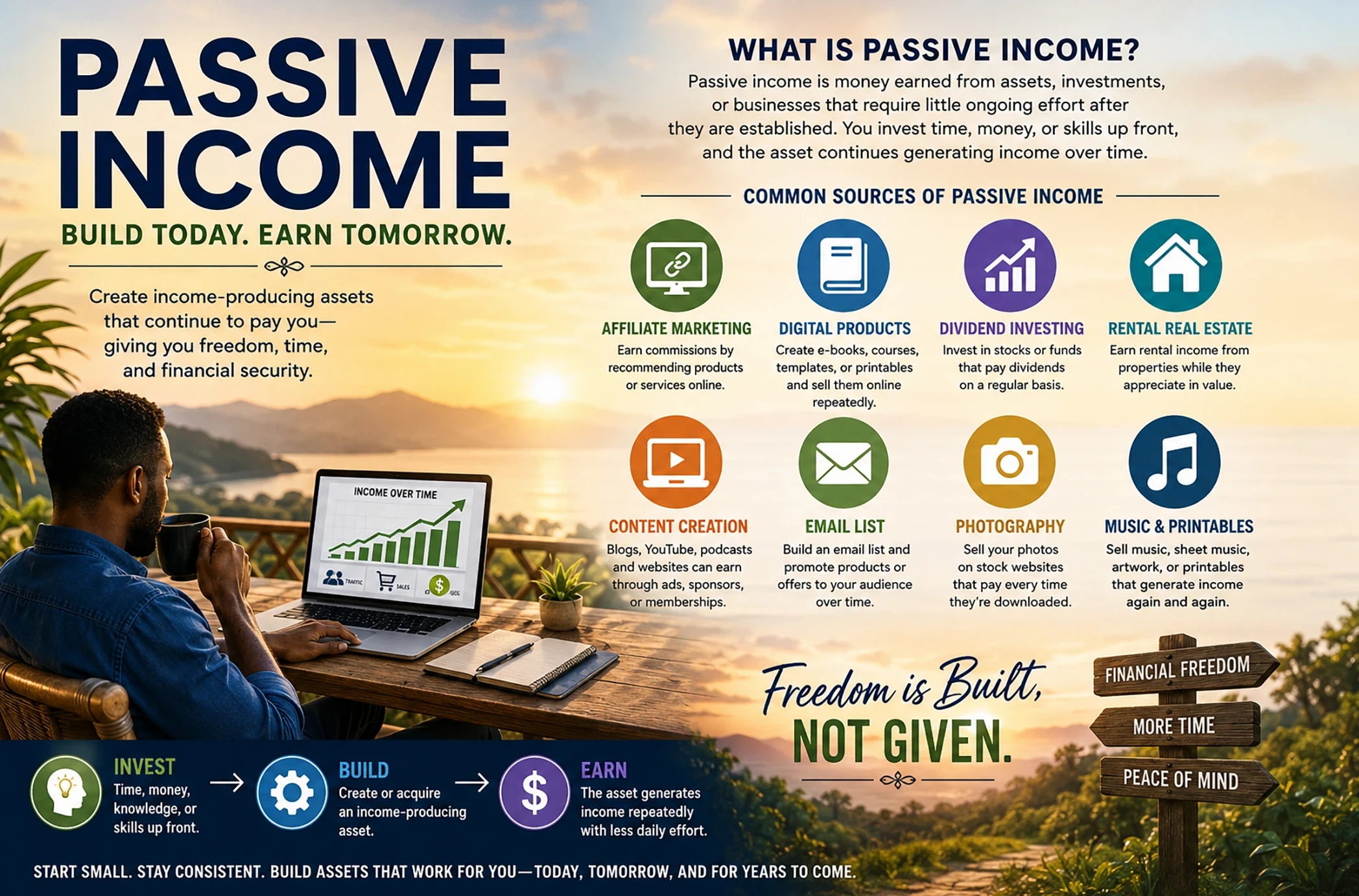
Passive income is money earned from assets, investments, or businesses that require little ongoing day-to-day involvement after they have been established. The key phrase here is “after they have been established.”
Many people mistakenly believe passive income means making money without doing any work at all. In reality, nearly every passive income stream requires significant effort, planning, learning, or investment upfront. Once the system is built, however, it can continue generating income with relatively little maintenance.
Think of it like planting a fruit tree. You must first prepare the soil, plant the tree, water it, and care for it while it grows. Eventually, the tree begins producing fruit year after year with much less effort than was required at the beginning. Passive income works in much the same way.
Active Income vs. Passive Income
To understand passive income, it helps to compare it with active income.
Active income comes from working. If you stop working, the income usually stops as well. Salaries, hourly wages, freelance projects, consulting work, and many small businesses depend directly on your time and labor.
Passive income, on the other hand, continues even when you are not actively working every day. Once the income-producing asset has been created or purchased, it can continue generating revenue on an ongoing basis.
This distinction is why many financial experts encourage building multiple streams of passive income. It creates financial stability because you are no longer relying on just one paycheck.
How Passive Income Actually Works
Every passive income stream follows a similar pattern.
First, you invest something valuable. This might be time, money, knowledge, creativity, or specialized skills.
Next, you create or acquire an income-producing asset. That asset could be a rental property, an online course, a blog, dividend-paying stocks, a digital product, or another business.
Finally, the asset generates income repeatedly. Instead of being paid once for your effort, you are paid over and over as customers purchase your product, tenants pay rent, or investments produce returns.
The more quality assets you own, the more opportunities you have to generate ongoing income.
Common Types of Passive Income
One of the most accessible forms of passive income today is affiliate marketing. In affiliate marketing, you recommend products or services through your website, blog, YouTube channel, email newsletter, or social media. When someone purchases through your unique referral link, you earn a commission. Once your content ranks in search engines or gains a loyal audience, it can continue producing commissions long after it has been published.
Another increasingly popular option is creating digital products. Unlike physical products, digital products never run out of inventory. They can be sold repeatedly without additional manufacturing costs.
Examples include:
Digital greeting cards
Printable planners
Devotionals
E-books
Online courses
Photography
Templates
Music
Graphic designs
Once created, these products can be sold automatically through online marketplaces or your own website.
Dividend investing represents another classic passive income strategy. Certain companies distribute a portion of their profits to shareholders in the form of dividends. By investing in quality dividend-paying stocks or mutual funds, investors receive regular payments while also benefiting from potential long-term growth.
Rental real estate has also created wealth for millions of people. Purchasing a rental property allows owners to collect monthly rent while the property’s value may appreciate over time. Although rental properties require management and maintenance, many investors hire property management companies to reduce their involvement.
Content creation has become another major source of passive income. Bloggers, YouTubers, podcasters, and website owners create valuable content that attracts visitors over time. Revenue may come from advertising, affiliate marketing, sponsorships, memberships, or product sales. A well-written article or popular video can continue generating income years after it was first published.
Why Passive Income Is Growing in Popularity
Technology has dramatically lowered the barriers to creating passive income. Years ago, building a business often required significant startup capital, employees, inventory, and a physical storefront.
Today, anyone with a computer and internet connection can create an online business that reaches customers around the world.
Website builders, e-commerce platforms, digital payment systems, email marketing software, artificial intelligence, and social media have made it possible for individuals to build income-generating businesses from home with relatively modest investments.
This accessibility explains why so many people are exploring passive income opportunities.
The Biggest Misconception About Passive Income
Perhaps the biggest myth is that passive income is “easy money.”
Successful passive income usually requires hard work at the beginning. You must learn new skills, produce valuable content, understand marketing, solve customer problems, and consistently improve your systems.
Many online entrepreneurs spend months creating content before seeing meaningful results. Others build websites that eventually attract thousands of visitors each month, but only after publishing dozens or even hundreds of articles.
Passive income rewards patience and consistency rather than shortcuts.
Building Multiple Income Streams
One important principle is diversification.
Instead of relying on one passive income source, many successful entrepreneurs build several.
For example, someone might own:
A blog earning advertising revenue
Affiliate marketing commissions
Digital products
An email newsletter
Dividend investments
Rental property
If one income stream slows temporarily, the others continue generating revenue. This creates greater financial security and reduces dependence on any single source of income.
Starting Small Is Perfectly Fine
Many people delay getting started because they believe they need thousands of dollars to invest.
Fortunately, many passive income opportunities require more time than money.
You can start writing blog articles, creating YouTube videos, designing printable products, publishing e-books, or building a niche website with relatively low startup costs. As your income grows, you can reinvest your profits into additional opportunities.
Consistency often matters far more than starting with a large investment.
The Long-Term Benefits
Passive income offers benefits beyond earning extra money.
It can provide greater financial flexibility, allowing you to work fewer hours or spend more time with family. It may help fund vacations, pay off debt, build retirement savings, support charitable giving, or provide peace of mind during unexpected financial challenges.
Over time, multiple passive income streams can compound. One successful project funds another, creating a cycle of growth that becomes increasingly powerful over the years.
While building passive income rarely happens overnight, the long-term rewards can be substantial for those willing to remain committed.
Final Thoughts
Passive income is not a get-rich-quick scheme. It is a long-term strategy for creating assets that continue producing income after the initial work has been completed. Whether through affiliate marketing, digital products, dividend investing, rental real estate, online content, or other business models, passive income is built by creating lasting value that people continue to use and appreciate.
The most successful passive income earners understand that every stream begins with learning, planning, and consistent effort. They focus on building systems rather than simply earning today’s paycheck. Over time, those systems can become reliable sources of ongoing income and greater financial freedom.
If you’ve been thinking about creating an additional income stream, there has never been a better time to begin. The internet has opened countless opportunities for ordinary people to build online businesses, create digital products, and earn recurring income from work completed today. By starting small, continuing to learn, and staying consistent, you can begin laying the foundation for passive income that may serve you for many years to come.
Ready to build your own passive income business? One of the most beginner-friendly ways to get started is through affiliate marketing. By learning how to build a website, create valuable content, and recommend products that genuinely help people, you can begin developing an online business with long-term earning potential. Take the first step today, stay committed to learning, and you’ll be well on your way to creating income that works for you—even when you’re not actively working.